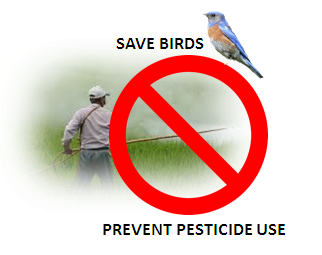
When birds fall prey to pesticides…
It’s no secret. For years, we’ve known that different species of birds in farmlands and grasslands have been in steep decline. The assumption was that this was due to habitat removal caused by agricultural expansion, deforestation to create concrete jungles that were once devoted to farming. What’s doing away with all those birds? Pesticides!
On a global scale, over 5 billion pounds of conventional pesticides are used annually for agricultural purposes, forest and land management, and disease control, as well as in homes, and on lawns, gardens, playgrounds, and other private properties.
What does this massive chemical flooding of the earth mean for the health of the environment? Birds provide some of the answers.
Population declines and extensive death of birds strongly indicate that the health of the environment, and thus the health of organisms that depend on it, suffers due to the irrational use of pesticides.
30 peacocks in Kutch killed by pesticides
Tanushree Bhatia; DNA │ November 17, 2018
A preliminary report by the Forensic Science Laboratory (FSL) on the death of more than 30 peacocks and peahens pins the cause of death in most cases as excessive use of pesticides. The large scale death of peacocks in Adesar sanctuary area in Kutch in September caused an uproar amongst wildlife enthusiasts, who suspected villagers had poisoned grains fed to 15 peahens and as many peacocks.
Wildlife safari operator and conservator Mujahid Malik says the state needs to swing into action immediately. "Excessive use of pesticides is not just harmful for terrestrial wildlife, it is impacting aquatic life as well," he said. "The rain washes the pesticides into rivers and lakes, where it impacts fish, frogs and turtles and upsets the entire ecosystem. Farmers are put under pressure to use pesticides to have an abundant harvest. The government needs to advise them on the correct right use pesticide and its side-effects."
14 peacocks found dead in agricultural field
Press Trust of India | Hyderabad │ July 26, 2018
As many as 14 peacocks were found dead in an agricultural field in Nagarkurnool district, forest department sources said today.
A week ago ten peafowls and one peacock were found dead in Gadwal district. It is suspected that they might have consumed some poisonous insecticides used by farmers in their fields to save their crops, the sources said.
Banned Pesticide Killed 13 Bald Eagles at Maryland Farm
By Julia Jacobs; The New York Times │June 21, 2018
When 13 bald eagles were found dead on a farm in Maryland two years ago, the cause of death was a mystery.
Details of a six-month investigation, disclosed last week, show that the eagles died from ingesting a highly toxic pesticide banned in the United States, a spokeswoman for the United States Fish and Wildlife Service confirmed Thursday.
Investigators determined the cause of death was poisoning by carbofuran, a toxic pesticide, said Catherine Hibbard, the wildlife service spokeswoman.
“It definitely was a human cause. This is not a natural cause of death here,” Ms. Hibbard said. “It probably wasn’t intentional to kill the eagles, but there was some target for the pesticide.”
There is an alarming trend between declines of local bird populations and use of pesticides in the environment, which needs serious attention to see what we want to do with this pesticide in the future.
What can be some effective steps towards abolishing the use of pesticides in our farms and environment?
We at C Tech Corporation have a unique, effective, and efficient way to tackle these pesticides and replace them with the pest repellent products that we manufacture.
The unique product CombirepelTM manufactured by C Tech Corporation is an anti-insect, anti-animal, anti-bird aversive which repels the pests.
CombirepelTM works on the mechanism of repellency. It is an extremely low concern, low toxic, low hazard, non-carcinogenic and non-mutagenic pest aversive. It does not kill or cause harm to the pests as well as to the environment which indirectly helps to maintain the ecological balance.
CombirepelTM is available in the form of the masterbatch, which can be incorporated into the polymeric applications like pipes, agriculture mulch films, floating row covers, greenhouse films etc. used for crop cultivation purpose. etc.
The product available in the form of liquid concentrate can be mixed in paints in a predetermined ratio and be applied to the fences in the garden and farms to keep the pests away from these places.
Our product in the lacquer form can be applied topically on the applications. The lacquer is compatible with most of the surfaces like wood, concrete, metal, polymer, ceramic, etc. The lacquer can be applied on the already installed pipes in the fields or garden, fences around farms and garden, walls of the warehouses where the agricultural produce are stored, thus protecting it from damage.
Our newly developed product in the form of spray can be sprayed anywhere to repel the pests. The product is compatible with all types of surfaces and can be used by anyone. The CombirepelTM pest repellent spray is safe for use in farms and warehouses.
CombirepelTM is thermally stable and does not degrade on exposure to heat and sunlight. It does not kill or harm the insect but repels them. It does not volatilize and does not degrade the soil. It is RoHS, RoHS2, EU – BPR, ISO, REACH, APVMA, NEA compliant and FIFRA exempted.
Contact us at technical.marketing@ctechcorporation.com to keep the pests away and decrease the use of pesticides.
Also, visit our websites:
http://www.ctechcorporation.com/ http://www.rodrepel.com/ http://www.termirepel.com/ http://www.combirepel.com/ Follow our Facebook pages at:
1] https://www.facebook.com/Combirepel-411710912249274/ 2] https://www.facebook.com/Termirepel-104225413091251/ 3] https://www.facebook.com/Rodrepel-120734974768048/
Follow us on our Twitter pages at:
1] https://twitter.com/rodrepel 2] https://twitter.com/termirepel 3] https://twitter.com/combirepel