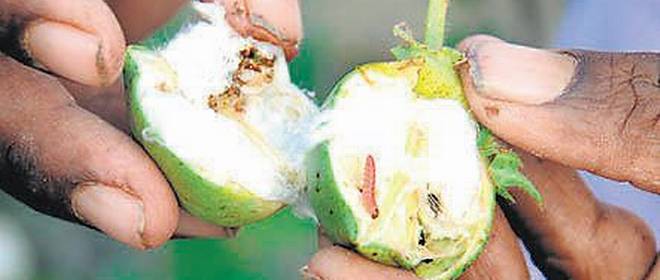
COTTON CROP UNDER THREAT
Cotton is a fantastic success story in India, catapulting it to the highest rank as cotton producer and second largest exporter. From about 17 million bales in the early 2000’s, production was more than doubled, generating genuine export surplus for the world market till 2017. But after that the world’s largest producer of cotton, saw losses due to pest infestations and is expected to decrease its total cotton plantation sites for the 2018-19 season.
Pink bollworm infestation is pushing cotton production estimates down in India this year due to crop damage in the country’s major cotton growing states. In a major disappointment for new entrant farmers, cotton crop has come under severe pest and bollworm attacks in major producing states, which is sparking fears of a sharp decline in India's fibre productivity this Kharif season.
While a substantial cotton area came under whitefly attack in Punjab and Haryana, pink bollworm was reported to have attacked standing crop in Maharashtra, Andhra Pradesh and Gujarat. Consequently, analysts have started revising estimates of cotton output growth for the current season to 4-5 per cent now from 10 per cent earlier on a sharp increase in the menace caused by these bollworms.
Last year, many farmers in Maharashtra, Andhra Pradesh and Telangana reported huge cotton output loss due to pink bollworm attack on the standing crop. The decline in output in major producing states prompted the government to reduce its cotton production forecast 5-7 per cent for harvesting season 2016-17.
India has seen a sharp increase in cotton production from a deficit country till two decades ago to one of the largest cotton producers. With its production between 33 and 38 million bales (one bale = 170 kg), India's annual cotton exports stand at 4-5 million bales. India sends cotton to China, Bangladesh and a number of other major textile manufacturing countries. Indian exports also include cotton yarn on a large scale to China and Bangladesh, among others destinations.
Bollworm management is based on scouting for eggs or small larvae. Treatment is recommended when 10 eggs or five small worms per 100 plants are present during early bloom in late July and early August. Preventative treatment that might be applied during the pre-bloom period is discouraged because this can destroy many beneficial forms that keep bollworms and other pests under control. Chemical control is seldom effective after worms exceed ½ inch in length (five days old, third instar). Once the cotton has blooms within four to five nodes of the top of the plant, the need for bollworm control is usually over for the season. However, the impact of late season treatments will depend on the weather and in some cases these late blooms can add to final yields and thus treatments may be justified if populations are heavy and the weather remains favorable.
News was reported that:
Pink bollworm infected 83 per cent cotton cultivation, says Maharashtra minister
By: Express News Service | Mumbai | Published: March 8, 2018
About 83 per cent of the farm land under cotton cultivation in Maharashtra have been ravaged by the pink bollworm attack, Agriculture Minister Pandurang Fundkar said on Wednesday. The pink bollworm (PBW) are known to eat away the cotton fibre and the bolls, causing economic losses to farmers. Fundkar informed the legislative assembly that the total crop loss had been measured at Rs 3,414 crore.
One of the ways to combat the moth is to set pheromone traps across their fields and catch enough of the male of the species to prevent any further breeding. But this primitive method of catching the Pink Bollworm is simply beyond the comprehension of the farmers. Firstly, you need at least 40 such traps per acre for these to be effective. Pheromones, mixed with natural ingredients like glossyplure, confuse the male moths who mistake the traps for females but farmers who have used it reported poor results.
Six farmers attempt suicide during protest in Maharashtra
Published by Pamela Raghunath, Correspondent │April 19, 2018
Indian farmers were protesting against government’s failure in not completing several development works when six farmers attempted suicide by drinking poison in front of the local administration’s office in Manvat, Parbhani district, Maharashtra, on Thursday.
On April 1, a 25-year-old distressed farmer, Bharat Survase, attempted suicide and is battling for life due to mounting debts and a failed cotton crop that was destroyed by the pink bollworm, a menace faced by cotton growers.
Earlier, a 75-year-old farmer from Yavatmal district had lighted his own pyre of fodder under a tree and immolated himself by jumping into the fire. The farmer, Madhav Shankar Rawate, had seen his cotton crop on his four-acre farm being destroyed by the pink bollworm attack. He owed Rs60,000 (Dh 3,346) to creditors.
So, what to use to keep these ballworms away?
TermirepelTM a C Tech Corporation product is best to deal with the nuisance caused by these pests.
Termirepel™ is thermally stable and does not degrade on exposure to heat and sunlight. It does not kill or harm the insect but repels them. It does not volatilize and does not degrade the soil. It is RoHS, RoHS2, REACH, ISO, APVMA, NEA compliant and FIFRA exempted.
Our product works on the mechanism of repellency. It temporarily inhibits the mating cycle of the insects. The product impairs the ability of the insects to reproduce, that is the insects will not lay eggs or the laid eggs will be infertile. The product causes feeding disruption in an insect by triggering an unpleasant reaction within the insect which might try to feed on the application. The product temporarily blocks the reproduction system of the insects by hindering the release of the vital hormones for growth.
Our TermirepelTM masterbatch can be incorporated in the agricultural films, polymer materials, green house films, polymer sprinklers, irrigation pipes, plastic parts from pumps and tractors used in the fields.
The product in form of liquid concentrate can be mixed in paints and be painted on the concrete walls around the farms.
Our lacquer product can be applied on already installed applications. The lacquer is compatible with most of the surfaces like metals, wood, polymers, concrete etc. It can be applied on the wooden fences around the farms and already installed pipes.
TermirepelTM does not kill the target species but only repels them thus balancing the ecology and thus helping in maintaining the goal of sustainability.
This product work on the mechanism of green technology. The product does not have any adverse effect on humans. Therefore significant in today’s time and date as ecology salvation has become the prime focus.
Get in touch with us at technical.marketing@ctechcorporation.com to combat the menace caused by brown plant hopper and other insects.
Also visit our websites:
http://www.ctechcorporation.com/ http://www.rodrepel.com/ http://www.termirepel.com/ http://www.combirepel.com/ Follow our Facebook pages at:
1] https://www.facebook.com/Combirepel-411710912249274/ 2] https://www.facebook.com/Termirepel-104225413091251/ 3] https://www.facebook.com/Rodrepel-120734974768048/
Follow us on our Twitter pages at:
1] https://twitter.com/rodrepel 2] https://twitter.com/termirepel 3] https://twitter.com/combirepel