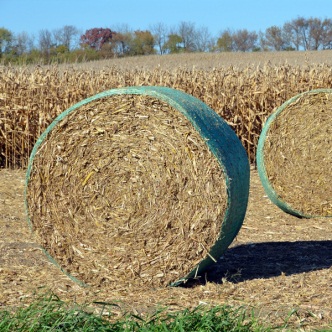
Bales and Birds
Over eight million bales of silage are made annually.
However, birds of various species like cockatoos, seagulls, galahs, magpies, etc. are a major cause of holes in baled silage. They cause tens of thousands of pounds worth of damage by letting air in.
The main reason found for bird attacks is simply that long grass grown for silage provides ideal conditions of protection and moisture for all things that birds love to eat such as worms, beetles, grubs, insects, etc. once harvested, this veritable feast is left exposed and the bird telegraph soon has every bird in the vicinity coming for the party!
Leaving the bales unprotected could raise the possibility of damage by birds. Hence, silage net is used to wrap the bales. Silage bales are an expensive commodity, therefore, protecting them should be a priority for farmers. The plastic stretch-film surrounding baled silage is prone to damage by birds during storage prior to being fed to livestock. The correct storage of silage bales is vital to preserve and retain the quality and nutritional value of the feed inside.
Protecting silage wrap from damage is vital when you consider that typically more than half of the silage in a bale is within 20cm of the surface. External damage caused by birds etc. is recognizable by the presence of holes along the tops and sides of the bales, the birds pierce the film straight through all the layers of plastic into the silage.
Evidences for same are given below: ‘Menacing crows’ feast on Munster fodder stocks
Breifne O'Brien, Agriland │July 18, 2018
A population of “menacing crows” is wreaking havoc on fodder stocks in Co. Limerick, according to Eddie Ryan, cathaoirleach of the Municipal District of Cappamore-Kilmallock.
Crow Damage
Commenting on the damage crows can do to fodder Ryan explained: “Damage to bales is just chaotic.”
He explained that some people think the birds are attracted to “something moving” on the bales – but Ryan believes they are eating insects.
The issue came up at a meeting of the Cappamore-Kilmallock Municipal District after the environmental director made a presentation on noise pollution.
Ryan outlined that the noise from crow-nesting areas is particularly significant from around 4:00am in the morning.
Calves ‘Spooked’
He also remarked that he has seen situations where young calves are intimidated by the presence of the crows and, as a result, they are reluctant about coming to eat their nuts.
On a more extreme note, he also added that he has seen magpies getting in on the act.
“This is no joke now, I’ve seen magpies stand on the trough and pick the calves on the face to keep them away from the nuts,” he said.
Although Ryan outlined how “menacing” the crows can be, he said he would never harm the creatures.
Stone the crows: the nuns who called in a hit squad
Michael Viney, The Irish Times │ April 21, 2012
Irish farmers now complain that rooks tear holes in the shiny black plastic stretched over their bales of silage; some even paint big white noughts or crosses on the bales as a charm or communal deterrent.
A Teagasc survey found birds – mostly rooks – guilty of damaging bales on 63 per cent of Irish farms, leaving their droppings and footprints on the plastic and, by letting in the air, making the silage go mouldy. It made no conjecture on the birds’ motivation.
Nor did it offer any relationship between the incidence of bird damage and the presence or absence of rookeries – small rookeries are abundant throughout the well-hedged farming countryside, and virtually all baled silage is within reach.
The silage cover is prone to bird attack and hence it needs to be made bird proof.
We, at C Tech Corporation have a unique solution to the bird menace. CombirepelTM is a product which is specially designed to prevent bird perching and roosting.
CombirepelTM bird repellent masterbatch is the product produced to prevent the menace caused by birds. The product available in the form of masterbatch can be incorporated while manufacturing the silage films. The product causes the bird's pain receptors associated with taste. Some birds use their sense of smell through which they recognize that the product is a threat. The product is specially designed to prevent perching and roosting of birds. Repellent evokes a physiological effect which the birds associated with sensory cue and then learn to avoid it.
Our CombirepelTM bird repellent lacquer can be applied on areas of farm to avoid birds from perching and roosting there. The product is anti-corrosive and water resistant and has no effect of UV light. The product is compatible with most of the surfaces and is easy to apply.
Thus using the bird’s sensory mechanism we can get rid of them without causing them any physical harm.
Our product is ROHS, ROHS2, APVMA, NEA complaint and FIFRA exempted. Our product is also compliant with the European Union’s Biocidal Product Regulation (EU – BPR).
Contact us at technical.marketing@ctechcorporation.com to keep the pests and birds away.
Also, visit our websites:
1] http://www.ctechcorporation.com/ 2] http://www.rodrepel.com/ 3] http://www.termirepel.com/ 4] http://www.combirepel.com/ Follow our Facebook pages at:
1] https://www.facebook.com/Combirepel-411710912249274/ 2] https://www.facebook.com/Termirepel-104225413091251/ 3] https://www.facebook.com/Rodrepel-120734974768048/
Follow us on our Twitter pages at:
1] https://twitter.com/rodrepel 2] https://twitter.com/termirepel 3] https://twitter.com/combirepel